Saturday, February 7, 2015

Reading Diary B Week 6: Kumbhakarna

            Kumbhakarna is a character who really sticks out to me.  For one, he is a Rakshasa who has a conscience.  For example, he urges Ravana to give Sita back to Rama because he believes that it is wrong to steal another man's wife.  However, Ravana's power and influence sways Kumbhakarna to fight Rama.  Kumbhakarna is interesting is his introduction.  He is introduced as someone who must sleep for six months for every day he stays awake.  Another thing is that they describe making this enormous breakfast, and then Buck describes Suka waking him up.  I thought that this part was hilarious because it takes the clashing of two giant cymbals.  It reminded me of trying to wake up a child or teenager to get up for school.  I thought it was a cute description, and it actually made me like Kumbhakarna as a character, which is why I hate what happened to him.

            The third and final reason that I found Kumbhakarna to be so interesting was what happened to him.  Kumbhakarna is described as a relentless warrior.  He will not die or give up.  In fact, he stays alive through a fatal arrow through his chest, losing both of his arms, and losing both of his legs.  After all this, Kumbhakarna is still described as trying to kill Rama.  “Still he managed to move, something carried him on,” (Buck 306).  After all that, Rama has to decapitate Kumbhakarna in order to stop him.  At first, I found Kumbhakarna to be really endearing, but after he has such intense hate for Rama, I don’t like him as much.  Aside from that, I think that Kumbhakarna is still an interesting character.
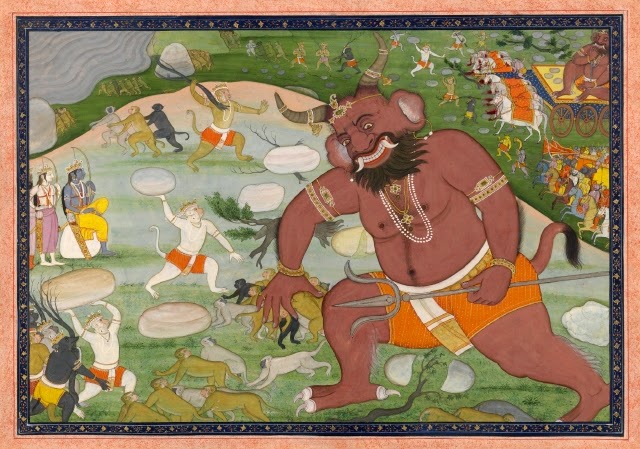
Kumbhakarna in battle. Source: Wikimedia

Reading Diary A Week 6: Sinhika

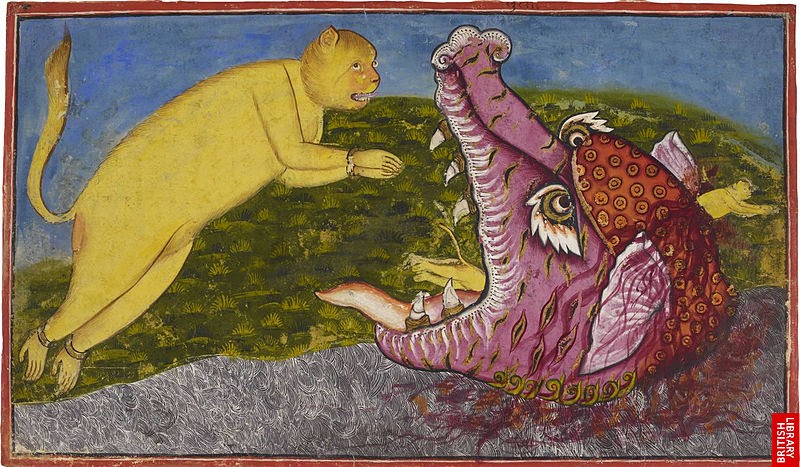
            Out of this reading section, the part that really struck me was Hanuman’s encounter with the Rakshasi Sinhika.  I know that this section is very short (less than a page which ranges between 226-227), but I liked that so little was told about her such as her back-story, which would make a possible storytelling blog.  Where did she come from?  How did she become this horrible sea monster?  What does her body look like?  Does she have any possible redeeming qualities?  Was she really that hungry to risk her life?  The part that I love about this section was the beautiful imagery that Buck uses.  Of course, this imagery that I have just described as beautiful is actually describing Sinhika as an ugly sea monster, but I love it.  As a writer, I gag when people use such creative imagery.

Some of my favorite quotes:
“...holding Hanuman’s shadow in her claws and looking at him with tiny red eyes,” (Buck 226).
“She opened her ugly mouth and bared her yellow scaly teeth,” (Buck 226).
“...with a long tongue,” (Buck 227).

            I felt that by describing her teeth as scaly was so creative.  I mean I would have never thought to describe teeth in such a way.  Overall, I love the descriptions that Buck gives about Sinhika.  I also really enjoyed Buck’s imagery of Hanuman and other parts of this section. 

Some of these quotes include:
“...his sharp fingernails,” (Buck 227).
“Her blood burst and spread throughout the water, and the fish came quickly to eat her,” (Buck 227).


            Essentially, this section caught my eye because of the wonderful descriptions.  I think it would make a great storytelling post.
Hanuman and Sinhika.  Source: Wikimedia

Famous Last Words Week 4

           This week I have actually been able to get ahead in most of my classes.  I wish I was farther ahead in this class, but overall, I am pretty happy where I am.  This week has definitely been better as things are slowing down, but I still wish that some of these big presentations that I have coming up would just be done and over with.  Other than those weighing heavy on my mind, school is good.

I’m pretty proud of my story this week.  At first, I was really struggling with finding something to write but I’m very happy with what I did.  I just have to remember to stop being so critical of my own writing because all that matters is that I just do it and get those points.  Something interesting that I did see when I was trying to the extra credit blog commenting was how different everyone takes notes.  For me, I always write out my thought in full sentences and paragraphs, but other people were using bullet points with few words and plenty of quotes.  Other people asked questions to themselves, which I thought was a great way to start the creative process for a storytelling post.

Nothing too important has been going on outside of this class except that I went shopping for niece’s birthday today.   Her birthday party is going to be My Little Pony themed, so I thought that it was only appropriate that I buy her something My Little Pony.  However, everything that Target had of My Little Pony was almost completely sold out.  For this reason, I thought it was safe to go with an Elsa jacket and some Hello Kitty accessories.  However, I did manage to find her a My Little Pony beanie.  I just hope that she’s happy with what I got her.  I mean what little girl doesn’t love a birthday present combination of Hello Kitty, Frozen, and My Little Pony.
My Little Pony.  Source: Wikipedia

Friday, February 6, 2015

Reading Diary B Week 5: Sita's Imprisonment in Lanka


            The part of this reading section that most struck me was Sita’s capture within Lanka.  While in Lanka, Sita has conversations with both Ravana and Indra.  Through her conversation with Ravana, the audience is shown multiple views of women.  For one, it explains how easily women are seen as property through rape.  Another thing that the audience sees is how fickle minded women are perceived to be.  For example, Ravana tells his demon servants to threaten her softly, use strong words, tell blatant flattery about Ravana, and give her everything she asks for and more.  Ravana believes that by doing this he can sway her to “love” him and sleep with him willingly.  Of course, as the story goes on, the audience understands that Ravana can no longer rape any more women due to a curse.  However, Indra gives us a back-story that explains that Ravana’s curse is due to him raping multiple women and raping one whose husband cursed him. 


            While this section does portray some negative views of women, it does give some positive views.  Through Ravana’s harsh curse, which states that once he rapes another woman all of his ten heads will explode, the Ramayana is stating that the rape of women is wrong.  Possibly by suggesting that all of his heads will explode not only infers that all rapists should be punished harshly, but also that rapists are mentally messed up.  Of course, I am an English major and we overanalyze everything.  While this passage has those redeeming qualities, I feel that at the end Indra’s statement, “‘I think women are more cruel than demons.  Very often they are,’” completely retracts those qualities and paints women in a bad light (Buck 180).  

Ravana and Sita. Source: Wikimedia


Reading Diary A Week 5: The Valakhilya

            Something that I found interesting about this reading section was the Valakhilyas.  While I really didn’t find the Valakhilyas interesting, I did find their descriptions about the demons and their actions intriguing.  The language that Buck used really struck me.  I thought it was beautiful and fascinating.  While I often find that too much descriptive imagery takes away from the plot or action within the scene, I found these descriptions to add to the action and keep me intrigued through this section of the story. 

Some of my favorite descriptions are:

“‘Rakshasas prowl for flesh by night.  They overshadow the darkness as though they would crush the mountains down.  We must endure demons and submit to them.  We have seen mountains of bones from the victims they have slaughtered, white bones, Rama, white bones...,’” (Buck 143).

“‘We hide from the Rakshasas of Lanka walking abroad through Dandaka, in form like hideous charred corpses from some cremation ground,’” (Buck 144).


            These descriptions of the Rakshasas from the Valakhilya are very disturbing.  By saying that they create mountains of white bones, Buck is inferring that they are killing so many of the Valakhilyas and other creatures that their bones create mountains.  Furthermore, the fact the bones are described as being white says that the Rakshasas have cleaned the bones so thoroughly by eating that they have turned white.  Another thing that I liked about this section was that Sita had a voice and actually stood up to Rama about starting a war.  However, Rama and Lakshmana quickly correct her thinking. 


Rakshasa.  Source: Wikipedia

Wednesday, February 4, 2015

Storytelling Week 4: Valmiki and Narada

            Valmiki was sitting quietly by the river, only opening his eyes to see the world around him.  By now, the anthill had covered the majority of his body.  The only body part that could be seen was his eyes.  Valmiki had planned to stay this way for another thousand years and possibly forever. 

            However, one day, Narada flew down from Heaven and asked, “Valmiki, will you help me?”

            “No, I’m too comfortable, and besides, the world offers me nothing that I cannot get by sitting within anthill,” Valmiki replied abruptly.

            “What can I say to you to make you do something besides live within that anthill?”

            “You really want to know what can make me move from this anthill?  Name one person, in the entire world, in the entire history of the world, who is honest,” Valmiki growled to Narada.

            “Rama,” Narada said smugly as he looked at the ground.

            “Rama?” Valmiki asked confused.  “Who is Rama?”

            “Rama is the ruler of Ayodhya.  He is the defeater of great Rakshasas such as Ravana and he is the only honest man the world has known.”

            “Why should I care about Rama?” Valmiki asked annoyed.

            “Perhaps you shouldn’t care about Rama, but you should care about his queen Sita, who has been abandoned by Rama.  If you do not comfort her when she arrives, she will surely commit suicide by throwing herself into the Ganga River,” Narada hastened in one breath.

            “Well, what did she do wrong?” Valmiki asked concerned.

            “Nothing,” said Narada shortly.  “She is the most virtuous and noble woman in the world who has been beside Rama through hardships such as exile and the death of his father.  She has done absolutely nothing wrong in her entire life,” Narada declared with pride.

            “Then why has she been abandoned?” Valmiki yelled, now even more confused.

            “Oh, well, the people of Ayodhya don’t like her so it is Rama’s duty as king that he abandon her.”

            “What?  You mean after all that, she gets tossed aside by the most honest man in the world, in the entire history of the world?”

            “Valmiki, I said he was honest, not a great husband.  So, will you help her?”  Narada begged.

            Without a word, Valmiki stood up and began to shake the dirt off that had previously covered his entire body.  He walked towards the river to rescue to Sita, thinking what mess this whole situation was to his search for peace.


Author’s Note
             I chose to tell the beginning of Buck’s version of the Ramayana.  I wanted to update the dialogue between Valmiki and Narada but I also wanted to focus on Sita’s situation, which is why I decided to leave out Valmiki’s duty of teaching the Ramayana to Rama’s sons.  My goal was to have a character who had a similar reaction about Sita’s abandonment to my own.  I just thought, “Really Rama? This is what you do to Sita after she has been beside you through everything?”  I know it’s only a story, but I liked the idea of Valmiki thinking that this situation doesn’t make much sense.  Other than leaving out Valmiki teaching the Ramayana to Rama’s sons, the rest of the story is true to the plot.
Valmiki.  Source: Wikipedia
Bibliography
             Buck, William (1976).  Ramayana: King Rama's Way.

Sunday, February 1, 2015

Styles: Week 3 Project

Topic: My Storybook topic is going to be the representation of women within Indian epics.  My goal is show four different examples within the Ramayana and the Mahabharata that demonstrate women being underestimated and mistreated due to their gender.  One story that I will be focusing on will be Sita’s trial by fire within the Ramayana.  Another story, I want to include is Ahalya’s story of being turned to stone by her husband.  I believe that both the Ramayana and the Mahabharata have several examples of women who are degraded because of their gender.  While I do believe that each is only defining the role of women within that culture and time period, I believe that it is not right.  I have not yet decided if each story should have a different female character or possibly the same character such as Sita. 

Bibliography:
Narayan, R. K. (1972) The Ramayana: A Shortened Modern Prose Version of the Indian Epic.

Sutherland, Sally J.  “Sita and Draupadi: Aggressive Behavior and Female Role-Models in the Sanskrit Epics.”   Journal of the American Oriental Society 109.1 (1989): 63-79.  Web. 30 Jan. 2015.                

Possible Styles:

Women as Storytellers: One possible way to tell this story is to give each of the women a voice because the Ramayana gives practically no firsthand accounts from females.  By doing this,
it would allow the reader to see firsthand how these women feel about being mistreated and how they have practically no choice to do so.  I feel that this would be the most powerful writing style in conveying my point. 

Men as Storytellers:  I know that this may sound odd, but these instances of women being treated poorly due to social customs could also be done through their oppressors.  I think I could write these stories with the men describing what an ideal woman is and how each woman does or does not live up to it.  By doing this, the reader will be able to see the blatant mistreatment of women.

Contemporary Comedy Version:
I know this choice is kind of broad, but I was thinking about having each of the characters being friends and telling these horror stories of relationships to each other.  It is kind of cheesy, but I was thinking about having them sit around while eating, like The Golden Girls or Sex and the City, and telling these stories.  I think it would be hilarious and a refreshing change to the original story.

Contemporary Drama Version: Instead of doing something funny like my previous post, I was thinking about writing these stories from the views of contemporary women who are struggling to be seen as more than a woman.  These women could all be in the same working profession and struggling to be taken serious by their male coworkers and bosses.  By making it more serious and even heartfelt, it would show these women as really struggling against female stereotypes.
Sita and her son Lava.  Source:  Wikipedia